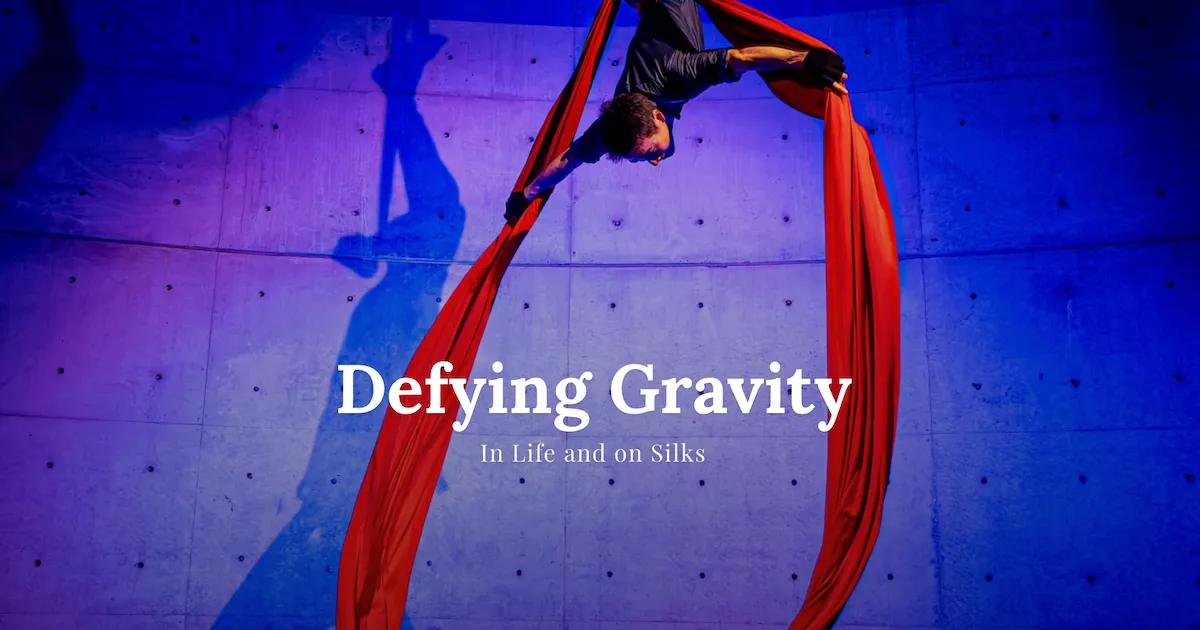
Continuing from my previous article, here is the second half of my notes on how to build an aerial silks routine.
People differ in their talents and the skills they have developed, and just as much in why they do aerial in the first place. The style that suits each person is different, and in the end you should feel free to build your composition and choreography however you like, but I hope some of this may still prove useful to someone.
—
First, to recap the framework from the previous article, I generally build a routine in the following order. The higher an item is on the list, the more important it is.
- Decide on one single wish.
- Decide what emotion you want to convey throughout the routine.
- Decide on the sequence of changes you want to show as the routine unfolds.
- Place the tricks, making sure there is enough variety and difficulty.
- Check whether your own individuality comes through.
- If possible, include something that works as a strong opening hook.
After that, you actually run through the routine and adjust it, paying attention to fatigue, musical counts, and timing.
Among steps 1 through 6, the lower the number, the higher the priority. In other words, if any two of them conflict or contradict each other, the earlier step wins out.
This time, I will cover steps 4 through 6.
—
4. Place the tricks, making sure there is enough variety and difficulty
This is where the pleasant task of endlessly scrolling through your camera roll begins, and basically, you start fitting the tricks you want to use, like puzzle pieces, into the skeleton you built in step 3.
To make the process easier to think through, and above all to give the routine enough variety to keep it interesting to watch, I try to include the following 5 elements (+1 more if possible):
- Drops
- Spins
- Power moves
- Flexibility poses
- Wraps that make distinctive use of the silks
- (If possible, release moves)
On top of all that, it also helps to set the following as requirements:
- Include at least 2 different types of climbs (at least 1 of them with some ingenuity to it)
- Use the full height of the silks, from top to bottom
Unlike industrial robots optimized for a particular motion, or narrow AI designed for a limited task, human beings are a remarkable example of general intelligence, one and the same body is capable of an extraordinary variety of completely different movements.
This one body of mine can do aerial in the air, swim underwater, play the piano, and sit here writing this sentence, and that versatility and adaptability are among the strengths of our species.
If that is the case, then surely one of the pleasures of an aerial routine lies in making use of exactly that human ability, the capacity of a single person to produce a wide range of different movements.
Of course, it is fine for some areas to be stronger than others, but I think keeping a reasonable balance makes the routine both easier to compose and more enjoyable to watch.
Depending on the level of the event and the audience you expect, I also check the following:
- Does the routine fully meet the expected level of difficulty?
- Does it include difficult sequences and transitions, not just isolated tricks?
Once you have roughly worked through this step and settled on your tricks, the transitions and flow between them start to take shape on their own to some extent, so by this point I think most of the composition and choreography will already be in place.
5. Check whether your own individuality comes through
By the end of step 4, the overall structure of the routine should be largely complete. But before you start full run-throughs, I think it is worth reviewing the whole routine once more, asking whether it actually feels like you.
Perhaps your strength lies in overwhelming power moves, exceptionally smooth flow, the ability to evoke imagery and scenery through expression, unexpected turns, or movement perfectly in sync with the music. By making use of what you are naturally good at, you can create a performance that is both more original and more natural, and leave an unmistakable imprint of yourself on the choreography.
If you can bring that out more strongly without sacrificing anything established in steps 1 through 4, it may be worth doing a little surgery on the composition, even at this stage. That said, I think the overall balance from step 4 should take priority over packing the routine with only the kinds of movements you are best at.
Rather than lining up nothing but tricks that showcase your individuality, I think your true strengths stand out most clearly when they are surrounded by a wide variety of tricks and movements and still refuse to stay hidden.
6. If possible, include something that works as a strong opening hook
Just as in a business pitch, it helps if you can jolt your audience awake right from the start with the sense that this one might be a little different.
In the same way that someone you cross paths with only briefly can sometimes change your life, I think an aerial silks routine benefits from having, within its very first moments, something that catches the audience’s eye, a hook that earns their attention immediately.
But this is only the cherry on top. It is certainly nice to have, but I do not think it is worth sacrificing any of the other elements for.
(7. Run through the routine and adjust it, paying attention to fatigue, musical counts, and timing)
By this point, you should have a complete first version of your composition and choreography. But once you actually run it, you will probably discover sections that put far more strain on your wrists than you expected, sections that feel far too rushed if you try to stay on the count, places where you run out of height sooner than planned, and transitions that somehow feel unnatural when you actually do them.
The strain, the sense that something is missing, and the awkwardness that only reveal themselves in a full run-through will keep surfacing forever, and composition and choreography are never truly finished. You can only keep approaching completion asymptotically, and I was constantly making changes to my own routine, updating it endlessly.
Any subtle unnaturalness that lingers in a performance tends to show up in areas like these (*1):
- Posture (Are the gaze, axis, knees, feet, and even your fingertips clean?)
- Execution of tricks (Accuracy, naturalness, and care in the transitions)
- Silk control (Unnecessary swinging or tangling, how smoothly you separate the silks, etc.)
- Connection with the audience (Eyeline, facial expression, whether you are truly looking at the audience and connecting with them)
- Fit with the music + variation in pace and space (Are stillness, movement, and pauses woven in to fit the tempo? Can you convey the mood of the music through movement and expression?)
- Whether any part has slipped into just going through the motions (Is there intention behind every movement?)
At first glance, it is easy to assume these problems simply come down to a lack of technique, but surprisingly often, the composition or choreography itself is partly to blame.
For example, execution problems such as a knee going soft at a certain point, the silks refusing to separate smoothly and forcing you to rush, or having no attention to spare for eye contact with the audience can sometimes be solved surprisingly easily by making a small change to the composition or choreography, swapping the order of two tricks, changing a grip, or inserting a new pose in between.
—
And when you run an early version several times and watch the footage back, I think you will still sense a certain mechanical quality to it: trick, trick, trick.
From there, you keep repeating full run-throughs, refining the flow from one trick to the next, drilling every movement into your body until you can perform it without thinking, and gradually shaping what began as little more than a series of tasks until it can finally be called a piece.
How many full run-throughs you can realistically do depends on your circumstances, but I think the ease that only begins to spill over once you can perform the entire routine without having to think at all is the true source of what we call stage presence.
That ease can give rise to, for example, facial expressions that come naturally and straight from the heart, and just by seeing the subtle differences in the curves and expressions of a human face, we find ourselves feeling happy, sad, or angry, or laughing, without even meaning to.
That is the kind of aerial silks performance I love, one where a story seems layered over it like a double exposure, and that has the beauty of fine craftsmanship, and it was what I strove toward, day after day.
—
*1) This is almost exactly the performance-quality checklist I used at the time, which I actually shared with my coaching team as reference material. Trying to work on everything at once only blurred the focus of practice, so I gave the items a clear order of priority. (In my case, the items nearer the top of the list, the lower-numbered ones, generally came first.)
I’ll be writing more stories for aerial lovers!
Subscribe to get notified when a new post is published.
 Tatz