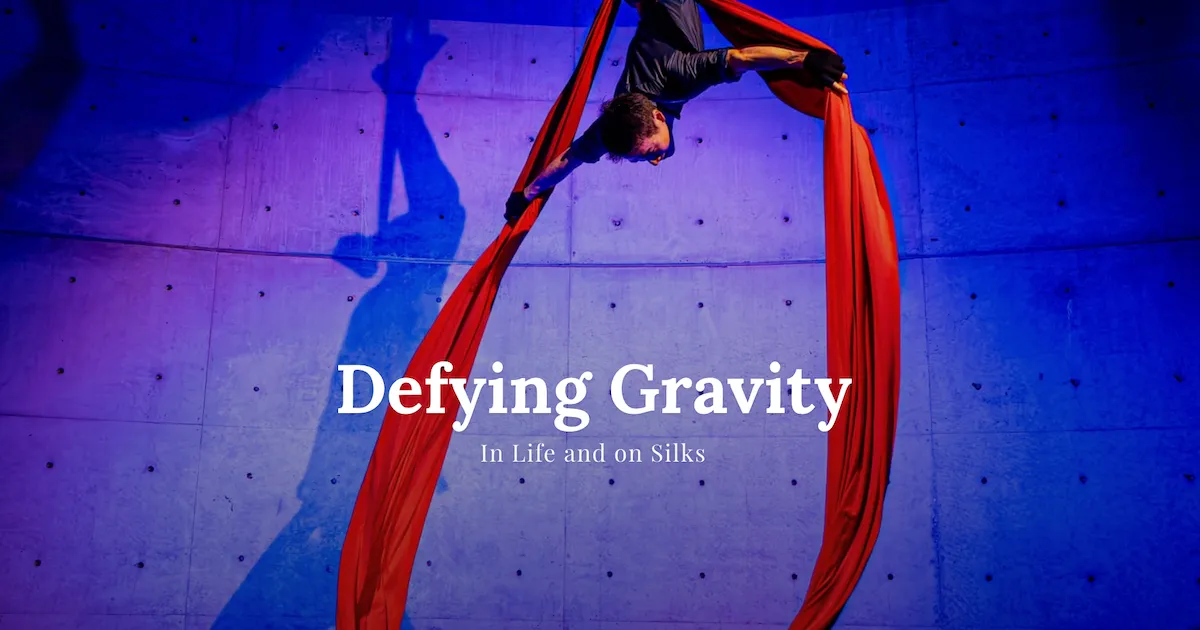
When I watched a professional aerialist whose body bore the unmistakable imprint of years of specialized training even before she had touched the silks, what struck me most was how few tricks she actually performed. (This ties in with what I wrote earlier about the letting-go rate.)
For all that physical ability and technique, and for all the difficult tricks she clearly had at her command, she brought surprisingly few of them into the performance, leaving long stretches in which she performed no trick at all.
It was a silks performance that might have seemed short on spectacle, perhaps even a little puzzling at first. She obviously had harder and flashier material in her repertoire, so why leave them out?
And yet the performance was captivating.
Even her fingertips on what ought to have been the most basic of climbs kept drawing the eye, every fleeting posture she passed through in the transitions between tricks was uncannily precise, and even her smile seemed to sway with the silks, as though caught up in the same intoxication, in a performance that almost defied description.
Perhaps it is something like the difference between someone who has to arch back with all their might just to open their chest and someone whose body could bend almost without limit but who chooses to unfold the spine only slightly.
The first may produce the larger, clearer, more spectacular shape, but the second leaves a whole range of motion quietly held in reserve somewhere deep in the body, and that sense of restrained possibility somehow lends the movement a greater depth in the eyes of the viewer. A body that could open further but chooses not to can make the movement still latent within it seem far more powerful than any shape stretched to its limit.
As if she carried within her the trace of all that unspent strength, the aerialist seemed to brim with ease, and rather than showcasing the spectacle that lay near the upper limits of her physicality and technique, she stayed within a range she could move through as easily as breathing. That ease became a brilliance of its own, and even the simple act of resting in the silks was so extraordinarily smooth that each passing moment seemed to stand out with crystalline clarity.
—
Benjamin Zander once observed of classical performance that as a pianist matures, the impulses fall on fewer and fewer notes until whole phrases, and eventually the entire piece, come to form a single long line, and that silks performance felt much the same, everything in it drawn into one continuous, graceful line. Perhaps that effect was possible precisely because the routine was so sparse in tricks (though the fact that it was a stage piece rather than a competition routine may also have had something to do with it).
This highly refined style, remarkably mature for someone her age, also draws on the lineage of contemporary dance, where fixed forms matter less and the body is given far more freedom to express emotion and narrative, and I suspect it was precisely that freedom and suppleness that drew me in. How exhilarating it must be to live like that.
Perhaps the idea that the more you let go, the better you become applies not only to aerial silks but to life itself, not tightening your grip in an effort to control things, but letting go, entrusting yourself, releasing tension, and flowing. Perhaps that is what it means to get better, and perhaps mastery in life is simply a matter of increasing the proportion of time you spend riding the current.
I suspect this is a perspective, and an ability, that I acquired less through my own progress in aerial (or piano) than through certain aerialists (and pianists) I came to know, and the way they lived their lives away from the stage.
—
But if that is true, then even this perspective and this ability must eventually become one more memory to let go of in a life where everything keeps flowing. However completely the mind understands it, letting go still takes courage. And yet once you have gently let go, all that is left is to let the current wash over it and carry you on.
Seen that way, there is nothing for it but to stop resisting. After all, I am not the only one who keeps flowing. If we managed to find each other in a life where we let go and fall, and go on falling as though we might never stop, then perhaps we can forget each other in much the same way, and what a strangely beautiful possibility that is.
I’ll be writing more stories for aerial lovers!
Subscribe to get notified when a new post is published.
 Tatz
 Tatz