Spin is often used to convey freedom or a sense of release.
And certainly, there is something in a rotating body that can intoxicate even the one watching it. But inside that impression, the actual design is considerably more sober.
Aerial silk spin is not simply a matter of turning. It is the total assembly of three elements: (1) how you initiate the rotation, (2) how you increase its speed, and (3) what you choose to show while you are spinning. That entire construction is what gives rise to the wide variety of spins.
To begin with, every spin requires a preparatory element: some movement that imparts the rotational motion itself.
The two most typical ways are: (1) to swing the silks broadly in the direction opposite to the body’s rotation, and (2) to create the rotational motion on the ground first and then climb into the silks. There are indeed other techniques for generating rotation without actually swinging the silks around in the air, but in any case, rotation does not suddenly arise of its own accord. It must be made, by means of some trigger.
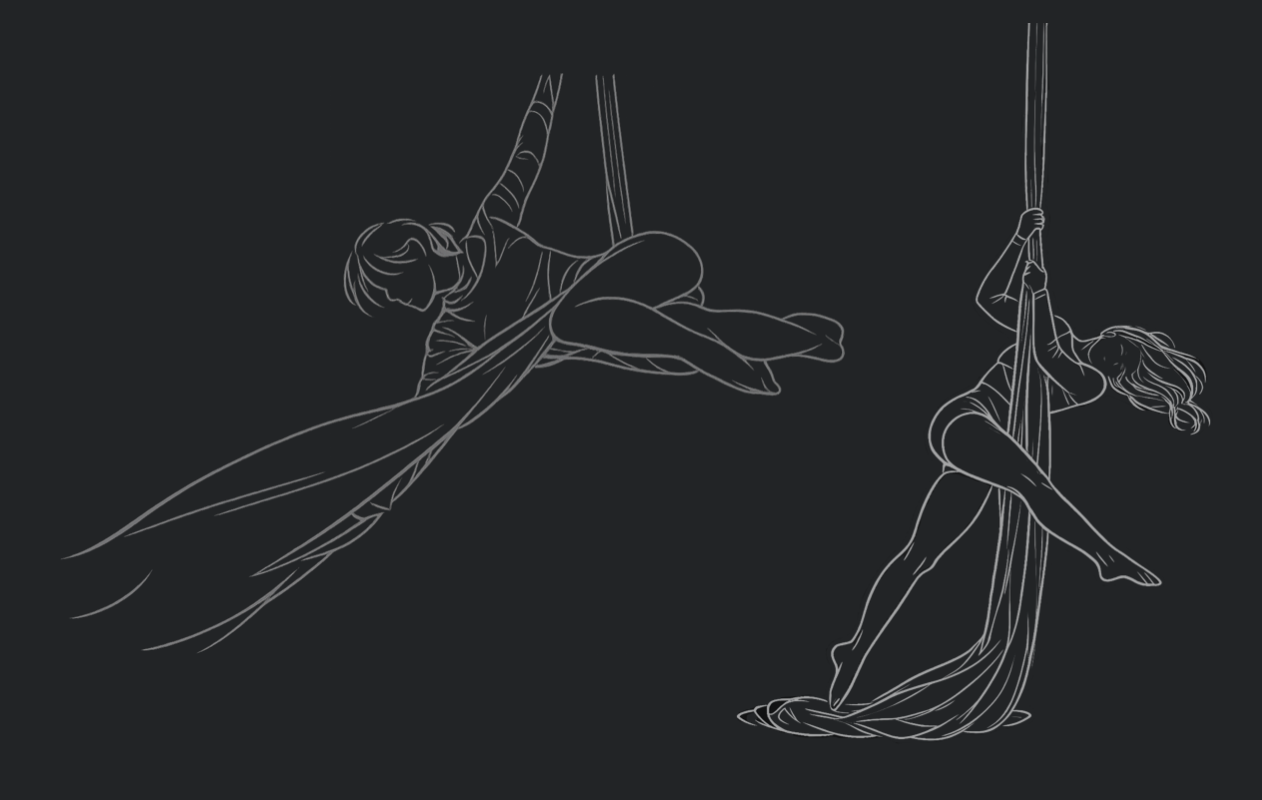
The second element is tightening the body to increase the speed of the spin. You gather the body vertically, align the axis, draw in a body that was opened wide so as to reduce its moment of inertia, fold back the legs that were extended far away so that they come closer to the axis. In this way, the spin becomes abruptly faster.
There is beauty in the mere act of a posture coming into order, and if the silks streaming with the rotation are made expressive as well, aerial silk can produce a form of expression in which beauty and natural physics coincide. (I, for instance, am fond of the way, in the DNA double-helix spin, the two silks swell softly outward under centrifugal force.)
DNA Spin
And the third and final element is doing another skill at the same time while spinning. A flexibility pose, a power move, a drop. You can perform these non-spin skills within the spin itself.
Which is to say, spin is not an independent skill so much as a background that can sustain another skill.
A spin, which shows the audience all directions across 360 degrees, has no such thing as a front. A move that works while stationary takes on an altogether different difficulty and appearance once placed inside a spin. Control becomes harder, and so the level of difficulty rises, but it is possible to do, for example, a roll-up in the middle of a spin, and it is possible to perform drop while spinning.
The finer nuances are endless, but these three are the basic compositional elements for designing aerial silk spin.
Whether you are trying to place a spin well within the structure of a routine, or devising a new spin that belongs to you alone, it becomes easier to find a guiding line if you break the problem down into these three elements.
—
The order of these three elements—(1) initiating rotation, (2) increasing spin speed, and (3) doing another skill during the spin—looks roughly like this.
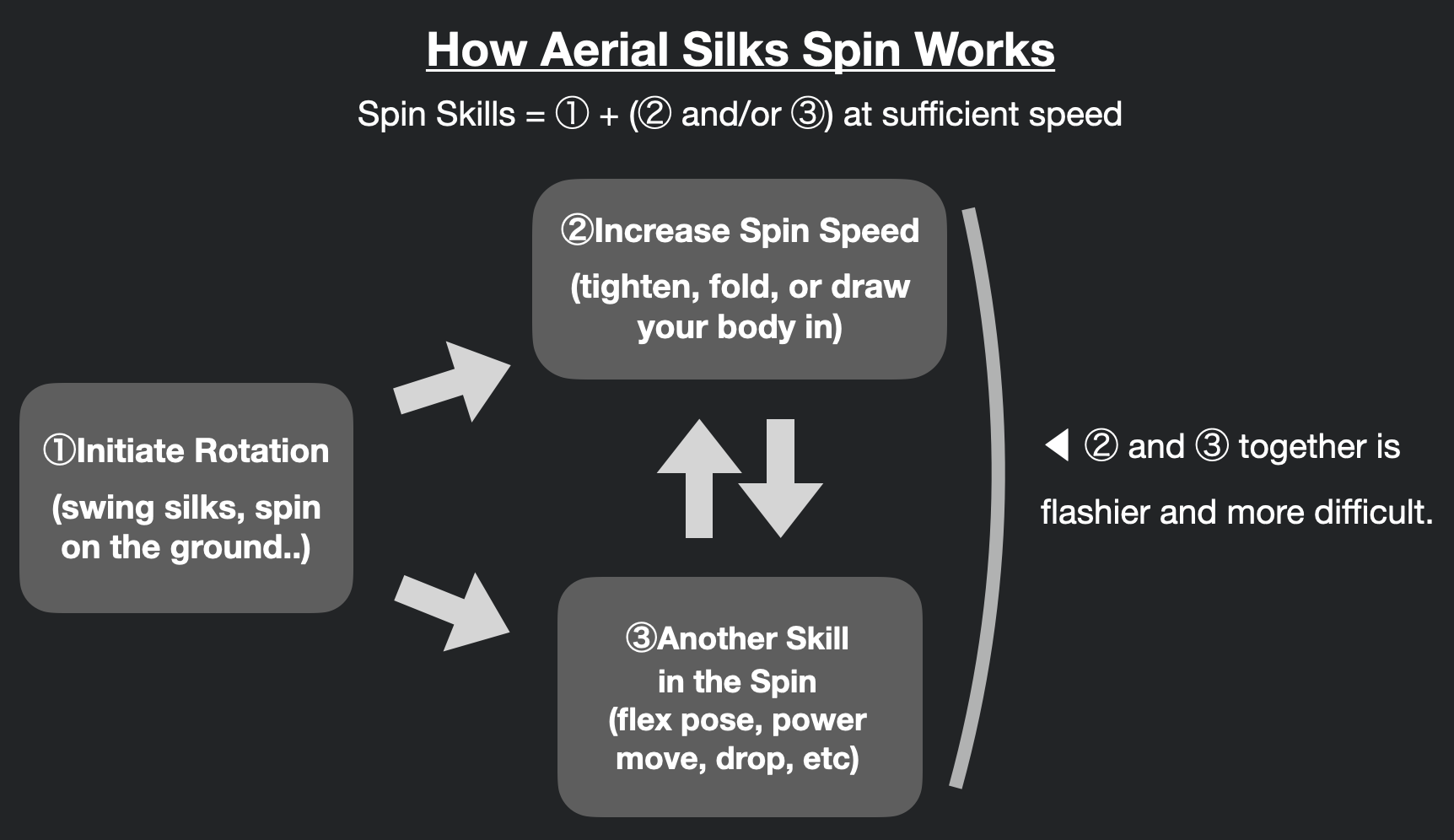
The simplest spin skills take either the form of 1 → 2 or 1 → 3, and once they are done above a certain speed, they become spin skills.
For example, doing a roll-up or showing a dramatic vertical split while maintaining a reasonably fast spin would be an instance of 1 → 3. (I assume 1 → 2 hardly needs an example.)
Now, if you do both 2 and 3 together—that is, if you create the rotation, then tighten the body within that same flow to accelerate it, and at the same time make another skill happen within it—the result becomes flashier to look at and more difficult as well. This is because both the amount of information the audience is taking in and the number of conditions you, the aerialist, must process, increase at once.
There are countless examples here too. One might initiate the rotation (1), perform another drop in the middle of the spin (3), and from there connect smoothly into a fast inverted spin (2).
The order of 2 and 3 need not be fixed, and they may alternate back and forth.
What is being used to generate the rotation? How tightly is the body being gathered, and how far is the speed being increased? What is being done during the spin? How do those three overlap?
The true difficulty of spin lies less in speed than in the conditions that are being stacked on top of one another. And its visual splendor, too, is the natural outward form of multiple demands running at once.
I think that aerial silk spin, in which not only the body but also the weight, lag, sway, and twist of the fabric all become part of the rotation, and in which multiple other skills can be made to happen within a complex sequence lasting tens of seconds, has a depth equal to, or even greater than the spins of gymnastics or figure skating.
—
Then how, in the first place, should you design such spin skills within your program and staging? Out of that infinite design space, what kind of spin passage should you make for yourself, or for the athlete or artist whose choreography you are responsible for?
That requires thinking from a rather different angle, so I think I will leave it for another article, separate from this one, which has tried to gather spin simply as a problem of bodily operation.
I’ll be writing more stories for aerial lovers!
Subscribe to get notified when a new post is published.
 Tatz
Tatz
 Tatz
Tatz