My field is computer science, particularly research and development in one branch of AI, and there, too, as in aerial, competition exists.
The most famous arena is probably the vast coliseum known as Kaggle. There is something exhilarating in the fairness of a stage where, simply put, whoever writes the highest-performing code wins. Those who pride themselves on being the ones who prevail, that is to say, the breed known as excellent engineers and researchers, in whom arrogance and ability are deliciously blended, cross swords day and night with one another all over the world, each trying to outwit the rest.
(This is an aerial blog, so I will not go too deeply into it, but if AI researchers happen to know an oddly large amount about the passenger profiles on the Titanic, Kaggle is to blame.)
One can enter as part of a team, or enter alone and stand on the same leaderboard on the strength of one’s own skill. I myself have competed solo and won a medal in an international competition with more than 1,000 teams participating, so I suppose I have earned the right to write an article like this.
Back when I was competing on Kaggle, from 2018 to 2020, there was a fellow researcher in the field who placed in a number of competitions.
I had thought of him as simply what he appeared to be: clever and gifted, diligent, fond of competition, just one of those people who are strong and always win. But according to him, in reality he experienced many more eliminations each year than placings. He told me, in substance, that behind one or two medal finishes in competition there were in fact, say, five eliminations, and that he had been making far more attempts than anyone around him would have thought. In other words, if you want to improve your record, then to begin with, you make many attempts. That was the advice he was giving around.
After hearing this, I began to make my target not success itself, but the number of failures required to make that success happen.
For instance, rather than setting a goal like “This year, I will win two competitions,” I would set a goal like “This year, in order to do that, I will be eliminated at least five times.”
If your target is two wins, then perhaps two attempts are enough. But the moment your target becomes five eliminations, the number of attempts required rises to at least five. As a result, you can no longer afford to drift through your days in a daze.
What is more, a target built around failure creates an incentive to take on difficult challenges. If all you do is attempt lukewarm challenges that you can clear easily, then you may succeed, but you will not achieve the one thing that matters here: failure.
—
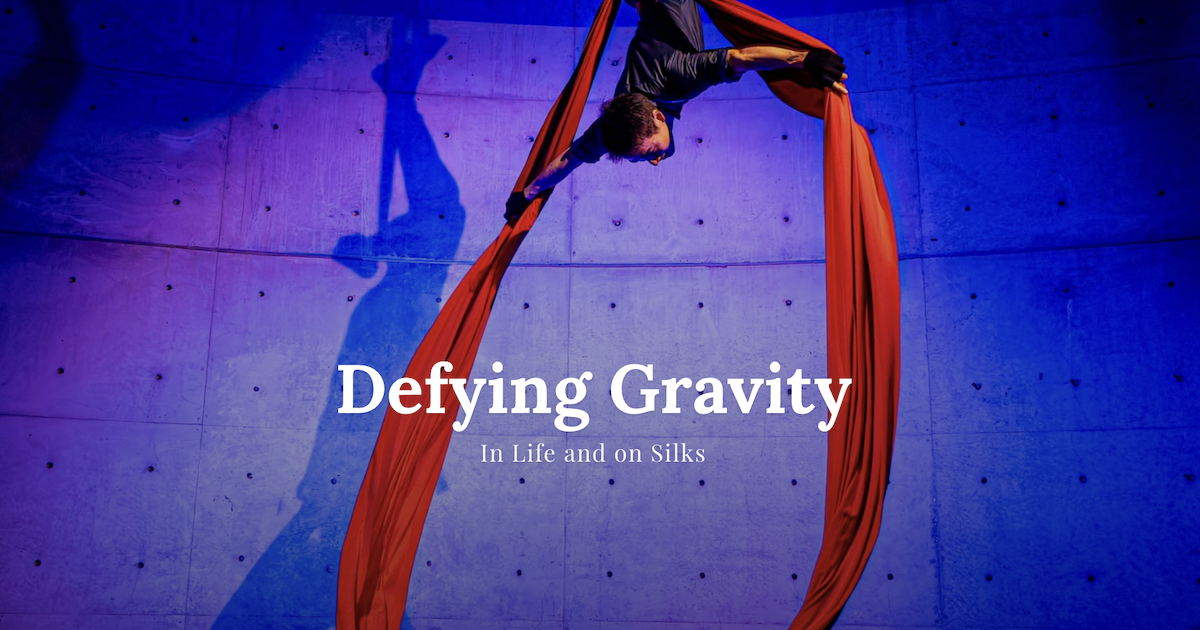
On my final aerial stage performance, I failed badly on a drop. It was a failure I had never once experienced, not even across more than 100 full run-throughs.
That failure was painful, and the price I paid for it was high.
And yet I still think I am glad that I failed.
Even now I remember vividly how I felt in that instant, and what I saw from the silks high up. It happened because it was my last stage performance, because I felt I had to pour everything out at last, and so I attempted a scale beyond my limit. If that is so, then this failure is also proof that I attempted something on that scale. Looking back, if that failure had not happened, it might have meant that I had not challenged myself enough.
I even managed to add one more failure to my count. Having set myself the goal of ten major failures a year, a single failure is no small gain.
—
I like arenas in which I compete against other individuals who are driven by the same ambition.
Kaggle suited me well, the astronaut selection exam was an experience rich in lessons, academics was a realm in which I was invincible, and aerial had excellent lunches near the studio.
Rosina Lhévinne, too, who trained many celebrated pianists at Juilliard, wrote the following in a letter persuading her student Van Cliburn, who would later become a superstar in both the US and the Soviet Union during the Cold War, to enter the Tchaikovsky Competition.
-You will practice furiously for the competition, and that will be good for you regardless of the result.
-As a result, your repertoire will expand greatly.
-At the competition, you will meet the finest rivals of your own generation and receive tremendous stimulation from them.
-And on top of that, perhaps you may even win first prize!
I feel exactly the same way, and if, on top of that, even failure allows you to accumulate failures, then there is absolutely nothing you lose by entering the arena!
It is all right to fail. It is all right to be eliminated. The true failure is to become unable to move for fear of failure, and if things go smoothly all the time, you will not even be able to fulfill your quota of failures.
This year too, I am a busy man accumulating failures.
I’ll be writing more stories for aerial lovers!
Subscribe to get notified when a new post is published.
 Tatz
Tatz