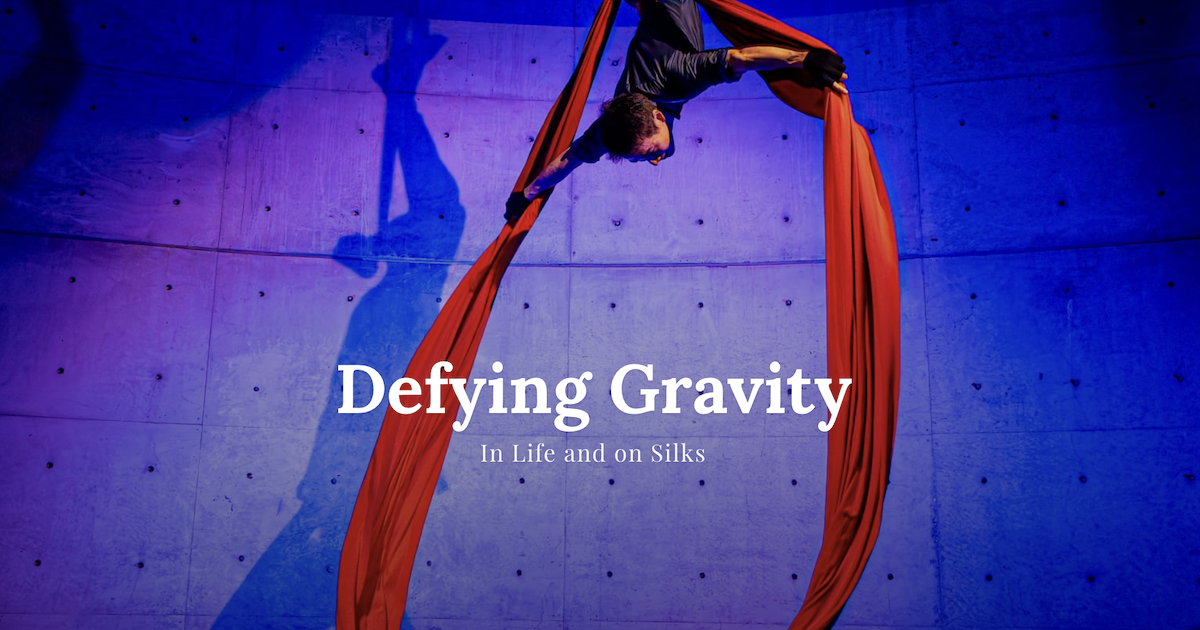
I loved those hours I spent practicing alone in aerial studios in midnight Tokyo.
There were two studios I used to rent in the dead of night.
One was a studio standing with a strangely composed face in the darkness of a residential corner of Roppongi.
Though it stood among wine bars and the like, that place alone seemed less a site of nocturnal pleasure than a facility cleaned for some more impersonal purpose. At the entrance there was a heavy door, and before it an expressionless concrete space, as though the underside of the building had been hollowed out. That space felt less like something meant to welcome anyone in than like an antechamber meant to sort and admit.
Only the image on the dark blue wall, a performer seated atop a crescent moon, drew the place back toward something poetic. In every other respect, it was closer to the entrance of an experimental facility.
Once I left the noise of the main road behind and turned into that suddenly quieter residential quarter, then reached that door at the far end of it, it always felt as though the city were still breathing just behind me, and yet only this side had arrived at midnight first. And each time I opened that heavy door, I liked the feeling that I was passing from the Tokyo night into another night, one slightly colder.
The other was a hall in Shimokitazawa, one that seemed less to appear suddenly in the middle of a residential neighborhood than to be slowly concealed by the road leading to it.
As you followed a narrow, winding street, the entrance would reveal itself with studied modesty. Beyond a small patch of open ground facing the road, there was a short flight of steps, and beneath that, the entrance door. Outside, it sat within the quiet of an ordinary residential district, untouched even by the fading residue of the bustle nearer the station. But once you descended the long staircase into the basement, you arrived at a semicircular hall that always retained that slight warmth peculiar to places where people gather, even when no one was there.
The movable mirrors like folding screens, the many lighting switches whose functions were at first impossible to decipher, the exotic animals kept there, all of them little by little kept the place from being merely a rental hall. When I used it alone late at night, I felt less as though I were practicing than as though I had somehow come into possession, ahead of everyone else, of a stage into which no one had yet entered.
—
Whichever of the two it was, midnight in an aerial studio was always a little like a laboratory. The lights were not there to illuminate people, but as inspection lamps, designed to draw out the shape of the silks with precision.
In a studio by day, human time inevitably flows in. Fatigue after work, the next appointment, the eyes of other people, small talk, the smell of ordinary life. By midnight, the noise produced by those healthy and ordinary human activities has slowly settled into silence, and what remains in the air becomes abruptly simple. Fabric, metal hardware, and your own body. Only then does the studio finally become not a sports facility and not a social space, but a single cold apparatus. I loved that kind of hour.
Even before touching the silks, the air is already slightly different. The floor is supposed to be the same floor it was in daytime, and yet at midnight it feels faintly harder. The outline of the mats, the metallic click of the carabiners, the dry resistance of the fabric against the hand, such details all become clearer than they are by day. When the number of people diminishes, objects themselves suddenly grow eloquent. Equipment, floor, and lights, which by day had withdrawn into the background, begin at night to assume independent faces of their own.
Aerial practice looks like a flamboyant performing art, but in reality it is a surprisingly humble accumulation of repeated experiments. If I enter at this angle, which way will the fabric escape? If I release the body for just an instant here, how much more uncertain will the axis of rotation become? If I delay the fingertips by half a step, how badly will the visible flow grow clouded? It feels less like handling a body than like manipulating conditions one by one and observing the result. The object, of course, is still your own body, but after enough repetition it begins to look less like a vessel of who you are than like an experimental material full of troublesome habits. The virtue of midnight lies in the way that observation grows colder.
It is not, of course, that midnight makes you improve by itself. But those few hours, slightly removed from human relations, with nothing before you but technique, were luxurious. Neither the moments that went well nor the ones that failed needed to be explained to anyone. I think I loved the precision of midnight nearly as much as improvement itself.
Perhaps that is what I had wanted from aerial all along. Not as a performing art meant to intoxicate others, but as a quiet apparatus for investigating, without interruption, the relation among my body, physics, and obsession.
I loved practicing late at night not only because I wanted to get better, but because, like astronomical observation, in that sealed room wrapped in the stillness of midnight, when the city lights had gone out, the air had cleared, and land, sea, and sky had dissolved into a single darkness, I felt I could observe more accurately than by day, exactly what I had done.
—
By the way, in Japanese aerial studios, even at night, even in the middle of the night, people cheerfully greet one another with "Ohayo gozaimasu!" (Good morning!).
At first I wondered whether everyone was just extremely nocturnal, but apparently in the worlds of dance and stage performance, "Good Morning" is the standard greeting even for evening lessons. From what I looked up, it seems to be a custom derived from Kabuki. As a small experiment, however, I once tried greeting everyone with Konbanwa! (Good evening!), and they all returned Konbanwa! without the slightest hesitation.
I’ll be writing more stories for aerial lovers!
Subscribe to get notified when a new post is published.
 Tatz
Tatz
 Tatz
Tatz