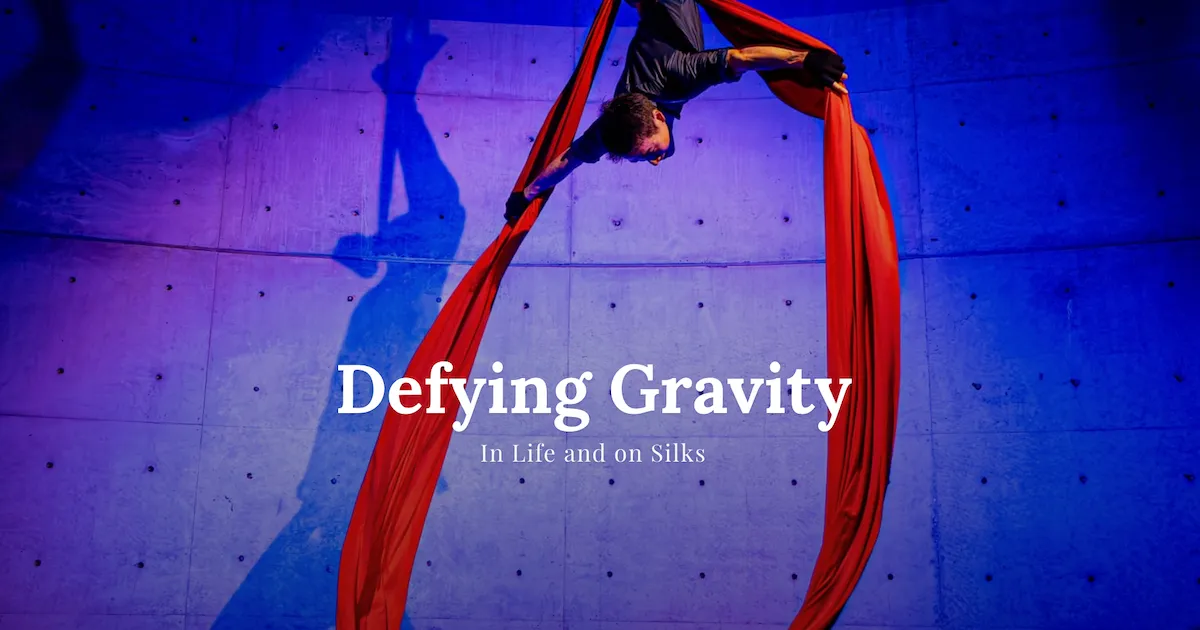
Asking a woman how much she weighs is generally considered bad manners, but for an adult aerialist, even a woman weighing somewhere around 440 lb (200 kg) is probably well within the normal range.
Of course, this is how you measure body weight:
- Drop onto a scale from a height of several meters.
- Write down the maximum number it recorded (if the scale was still alive).
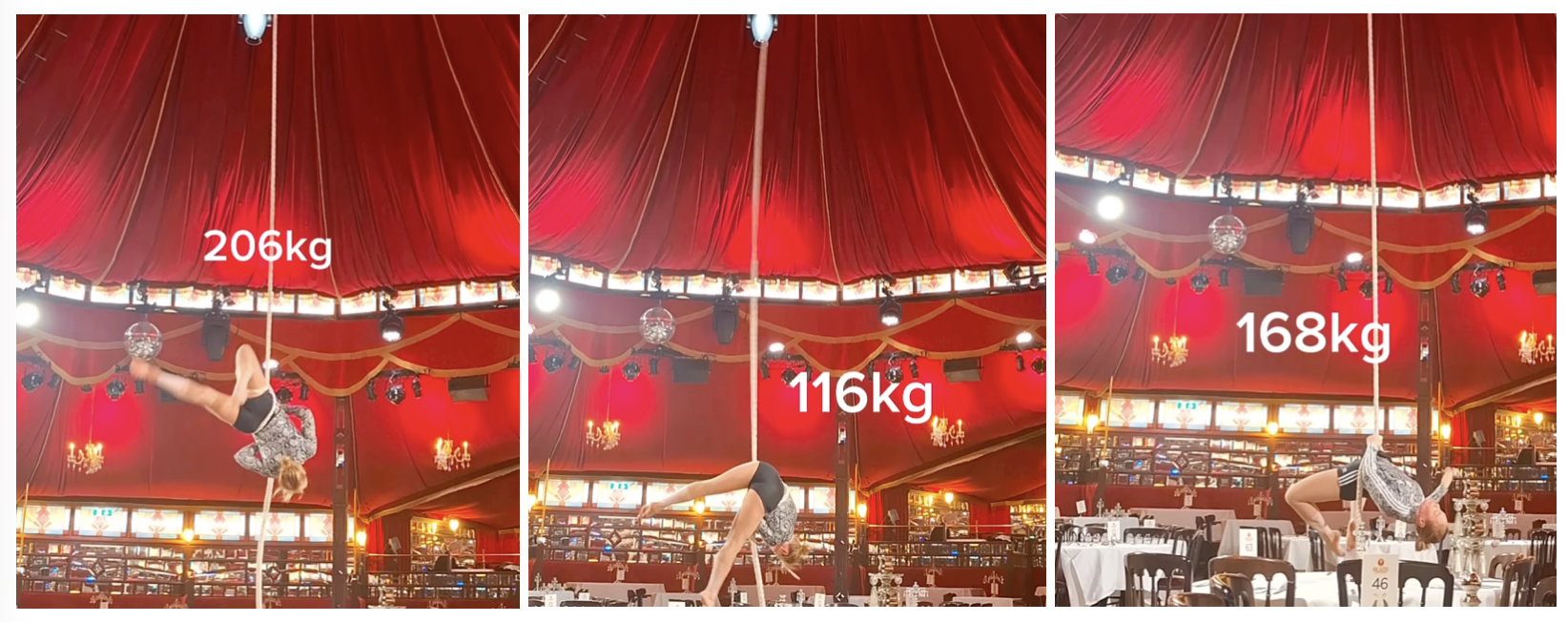
Naturally, the farther you fall, the more you weigh. Every aerialist knows this. (*1)
—
As is well known, the safety of a system as a whole is limited by its weakest component. (*2)
Besides the silks themselves, an aerial silks setup usually involves various pieces of hardware: carabiners, a swivel if you want to spin, a figure 8 for attaching the fabric itself, etc. If something in the system is going to fail, it will be the weakest component, so there is little point in assembling a collection of extremely strong hardware if even one weak piece is mixed in.
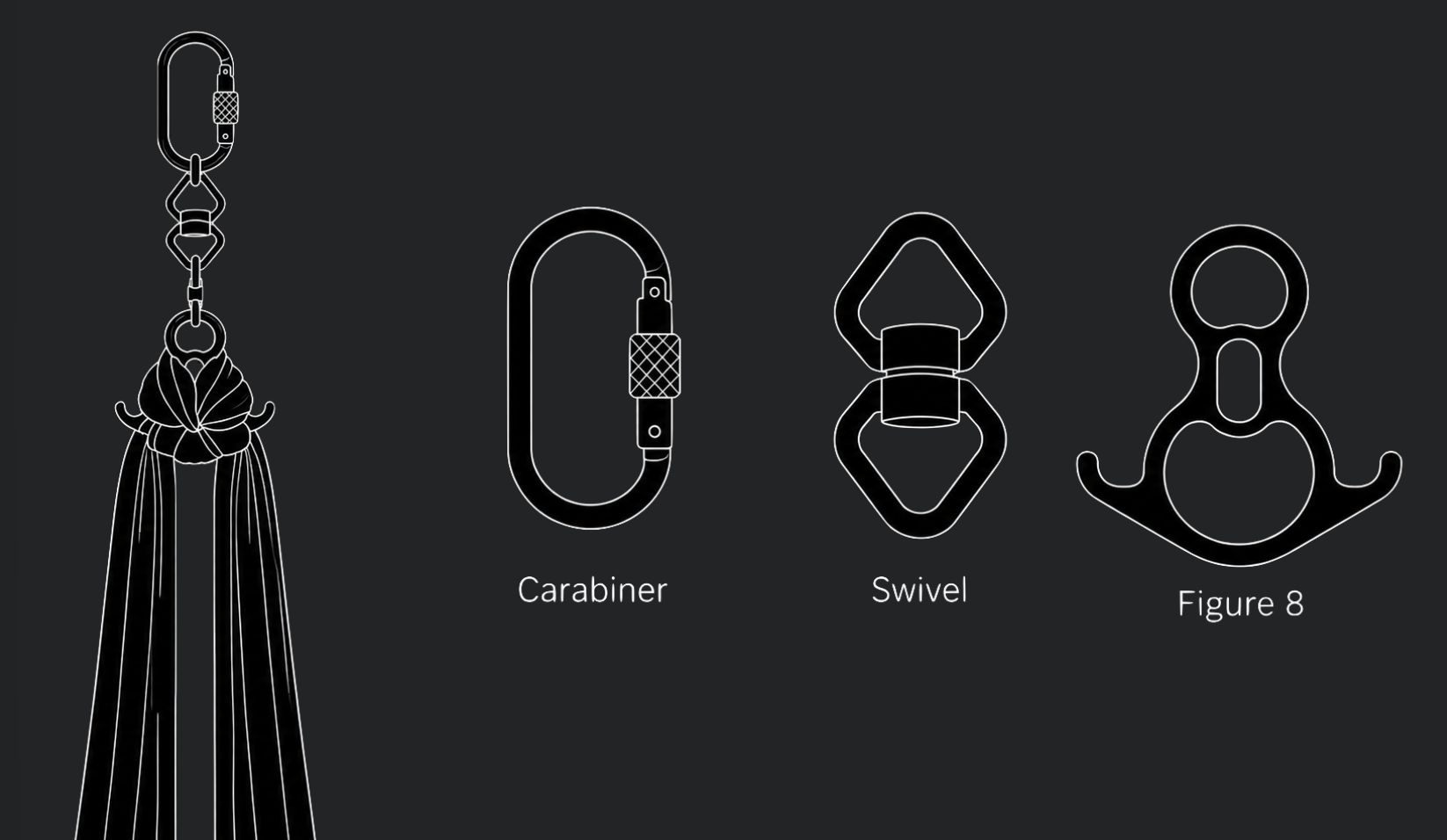
The strength of carabiners, swivels, and figure 8 are often given in kN. To give the conclusion first, if a trustworthy catalog lists a breaking strength of 25 kN or more, roughly 5,600 lb-force (2,500 kg-force), that will probably be sufficient in most cases, and hardware around that strength is easy enough to find. (*3)
—
The fabric itself is a different matter. Ordinary product specifications often do not list either a safe working load (WLL: Working Load Limit) or a breaking strength (MBS: Minimum Breaking Strength), so in many cases, if you really want to know how strong the fabric is, you eventually have no choice but to test it yourself. Strictly speaking, the same is true even when you buy fabric with an established history of use for aerial silks, if those figures are not included in the published specifications.
But some suppliers that specialize in circus equipment do publish breaking-strength data, and Prior Fitness for example is a useful reference.
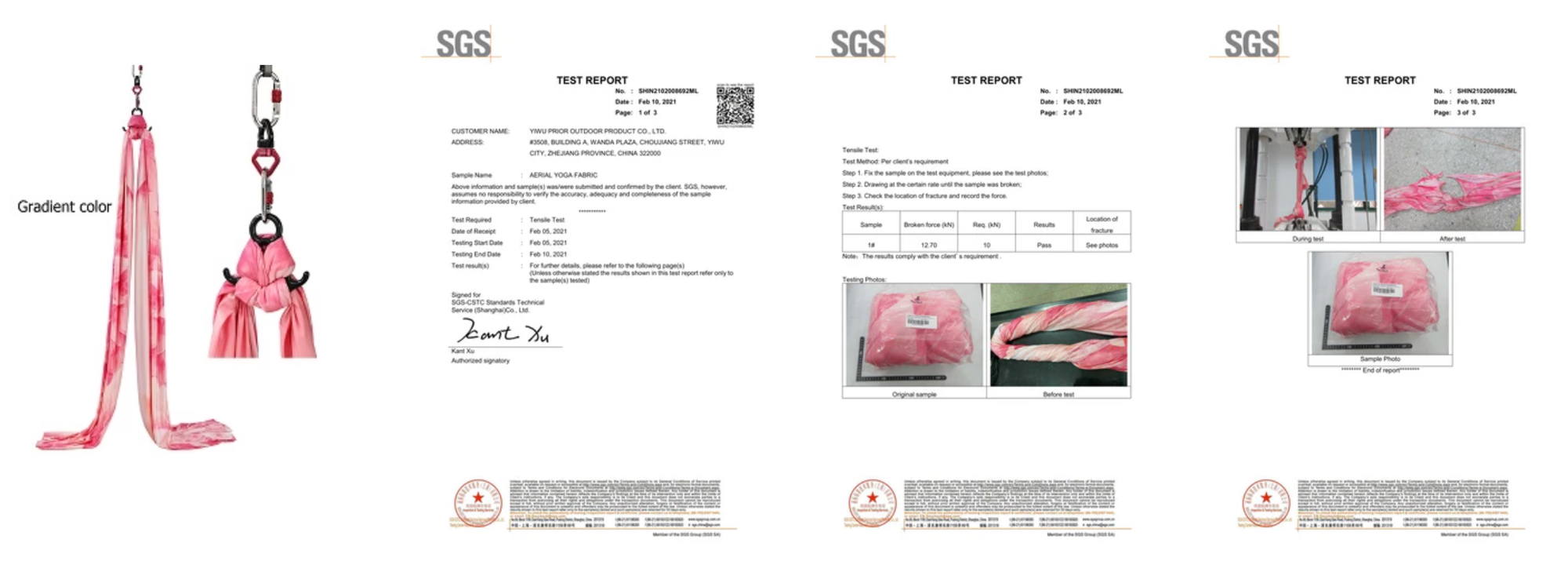
For the silks listed there, the required breaking strength is given as 10 kN, with an actual measured result of 12.7 kN. Judging from the photograph on the right, the fabric appears to have been folded and mounted on the test fixture as a doubled bundle, so I assume the result means that the complete sample in that configuration broke at 12.70 kN.
Compared with the 25 kN figure used above as a rough standard for carabiners and similar hardware, this may sound rather weak, but perhaps that is simply what one would expect from silks, which (unlike aerial hoop and similar apparatus) almost never have to catch a completely free-falling human body. Carabiners and figure eights probably have their origins in climbing and related fields, while fabric comes from the worlds of dance and circus, so perhaps the numerical standards and conventions developed differently.
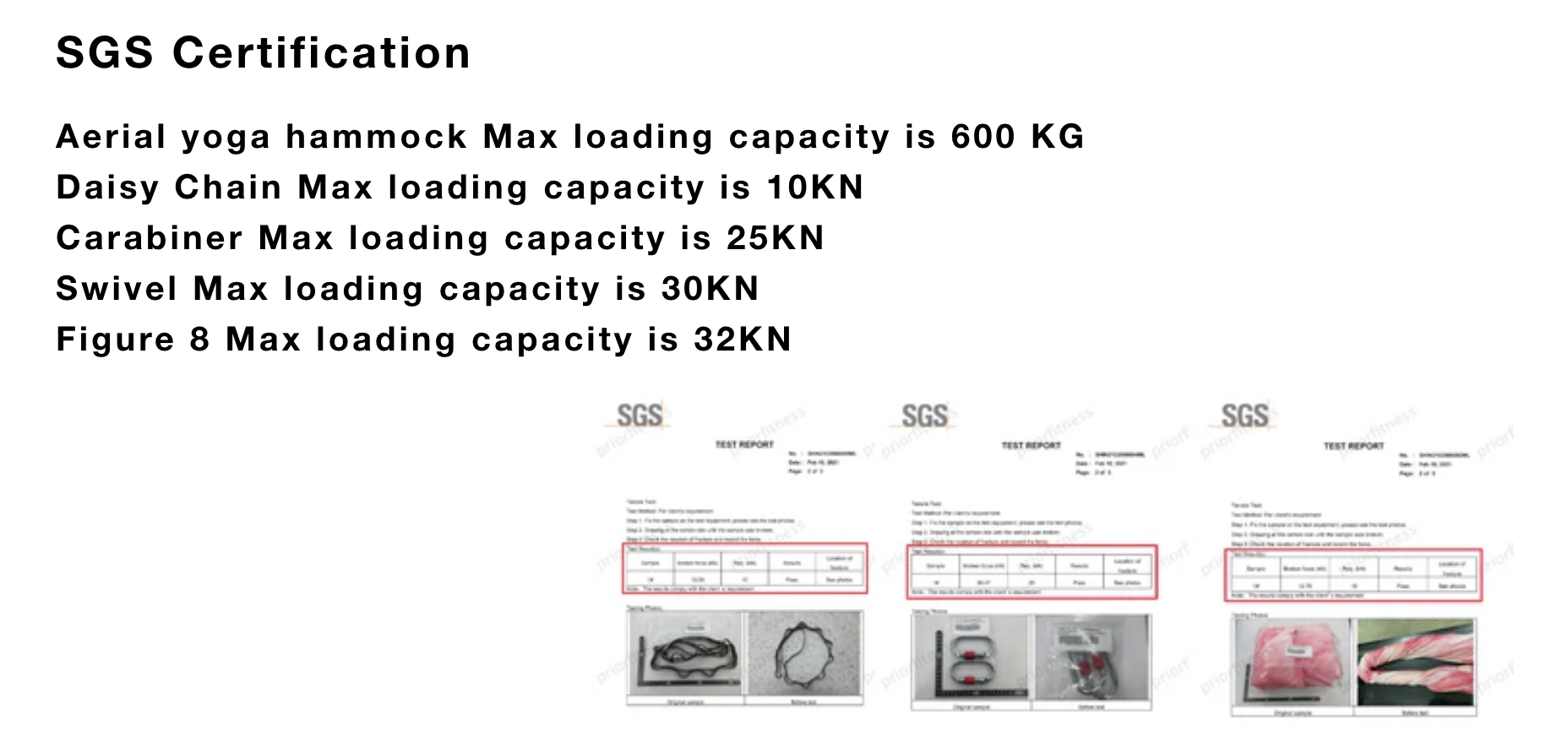
A required breaking strength of 10 kN, roughly 2,200 lb-force (1,000 kg-force), also appears for things such as daisy chains and slings used for length adjustment, so perhaps 10 kN is one realistic benchmark for equipment used in aerial silks. (*4)
The product description for silks sold by another specialist circus supplier, M-POLE, also lists “WIL 220kg (485 lb),” which points to roughly the same level. (As a general rule of thumb, the Working Load Limit, or WLL, is often taken as about 1/5 of the breaking load.)
Of course, I have absolutely no intention of claiming that a strength of around 10 kN guarantees safety. But I think it is fair to say at least this much:
- If you are using fabric with a breaking strength below 10 kN, it may be dangerous unless you keep the use fairly gentle. (Put simply, I would not recommend it.)
- And if you judge the strength of the entire system only by the 25 kN ratings on the carabiners and figure eights, you may overlook the relative weakness of the fabric or slings.
—
So, as aerialists, suppose we find a fabric we want to use and decide to test its strength. In the simplest physical model, the breaking strength of a material does not change merely because the sample is longer. In other words, the force required to pull apart a 20 in (50 cm) sample of fabric is the same as the force required to pull apart a 50 ft (16 m) of fabric you would actually use for aerial. That is useful knowledge.
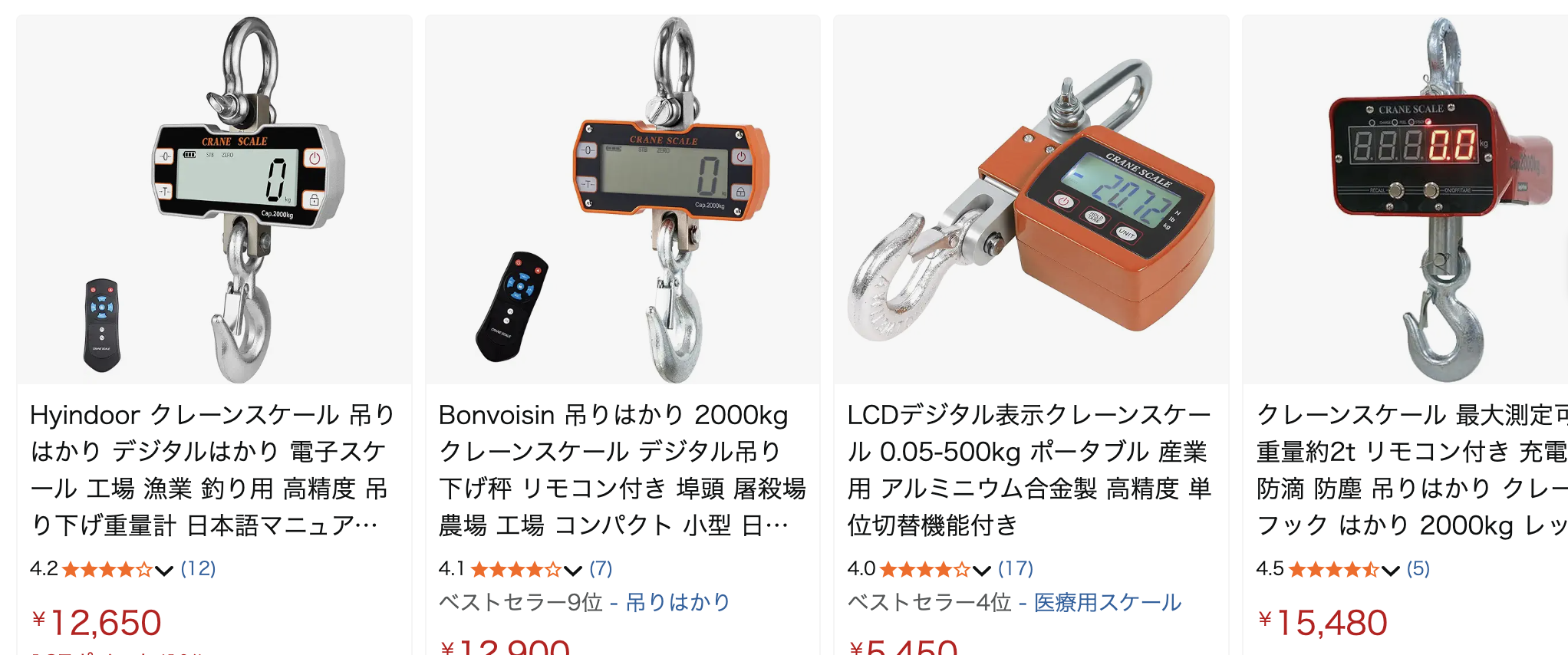
To record the load during a tensile test, you would use something such as a force gauge, tension gauge, or crane scale, and instruments capable of measuring up to around 4,400 lb (2,000 kg) can be bought for roughly $150.
If we take 10 kN ≒ 2,200 lb (≒ 440 lb WLL) as the minimum level we want to test, then we would want to fold the fabric in two and apply around 2,200 lb-force (1,000 kg-force). The problem is that the average household does not usually have a convenient way of producing that kind of load.
As an easy compromise and an admittedly crude thought experiment, suppose we decide that each single strand should have a breaking strength of at least 1,100 lb-force (500 kg-force). In that case, a realistic starting point might be to hang a single strand of silk and see whether it can support 9 or 10 people weighing around 110 to 120 lb (50 to 55 kg) each. (Again, this is an extremely rough interpretation, so please take it with a very large grain of salt.)
—
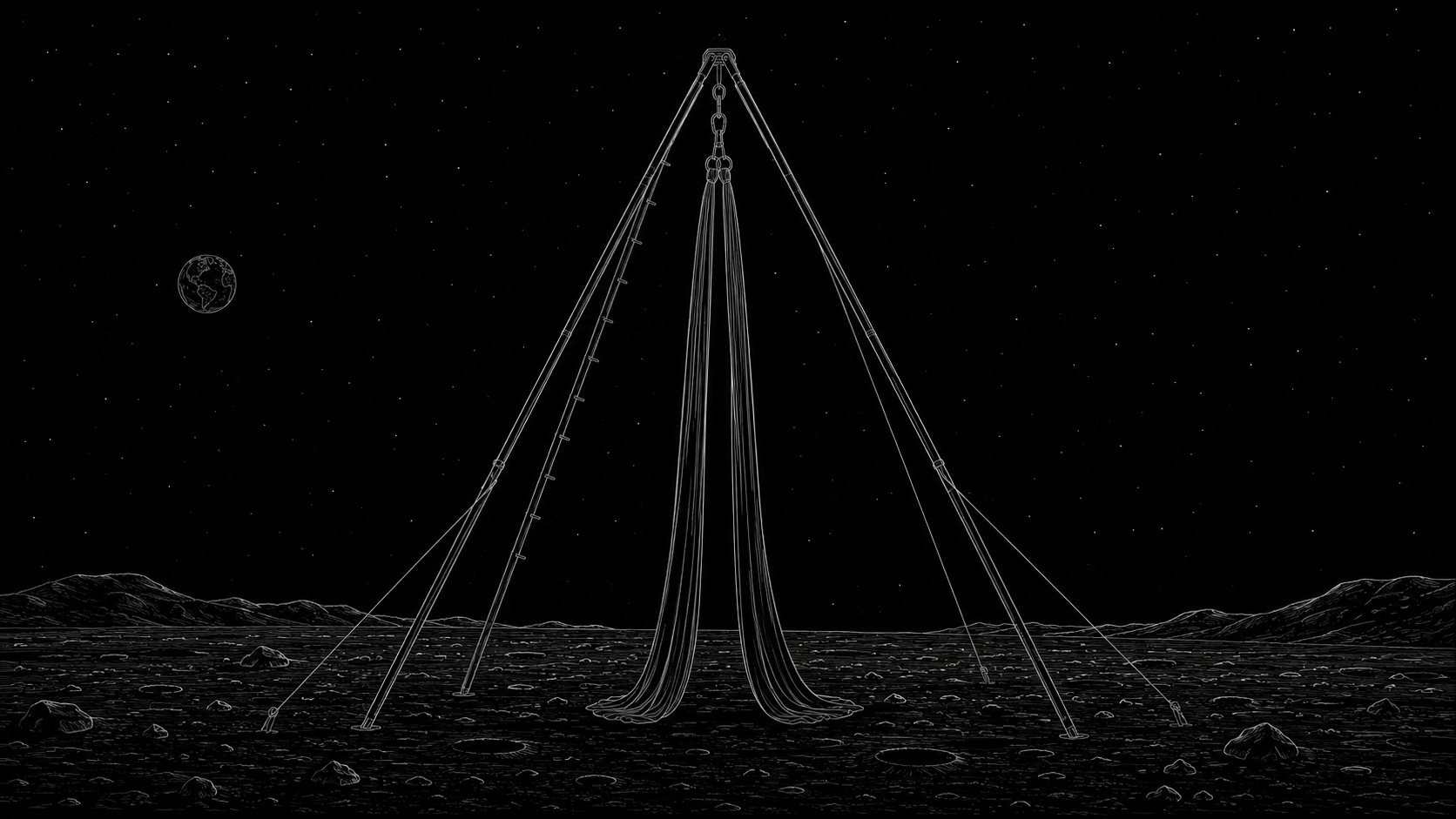
There is also a more fundamental alternative: if you absolutely cannot confirm the strength of a fabric you desperately want to use, you could simply do aerial silks somewhere with weaker gravity than Earth, such as on the surface of the Moon, or inside a room that is itself in free fall.
Gravity on the Moon is about 1/6 of Earth’s, so if a fabric can safely hold you on Earth, dramatic drops on the Moon should probably be no problem. (Of course, if you perform outdoors as in the illustration above, you would also have to take things such as the weight of the spacesuit into account..)
As of 2026, the realistic first step is therefore to apply for astronaut selection for the next lunar mission.
—
So far, I have treated everything from the carabiners downward as a single system, but if you follow the load path upward, there are also the slings used for length adjustment, the ceiling anchor, and, of course, the beam and the building itself.
In other words, anchors, beams, and all the other load-bearing components should also be checked for a breaking strength of at least 10 kN, and, as sensible adults, we should probably be using 25 kN as the standard benchmark. If you use shackles or rigging plates, the same basic way of thinking applies to their required strength as well.
The final setup should of course be discussed with a professional rigger, but I think it is useful to have at least an intuitive grasp of the ideas covered in an article like this.
To every aerialist setting out to build a setup of their own:
Stay safe!
—
*1: For example, this reel👇 uses rope rather than silks, but the reference values are displayed very clearly:
*2: Strictly speaking, this statement applies only to a simple series system. If the system has redundancy or a fail-safe design, the weakest component does not necessarily determine the safety of the whole system. For various reasons, however, it is difficult to build redundancy into an aerial silks system. Fail-safe measures often go no further than nets or crash mats, which can also be difficult to use in an actual stage environment.
*3: 25 kN represents roughly 5,600 lb-force (2,500 kg), but that does not mean it can safely hold a 5,600 lb object (or people). It means that at around that force, the carabiner may break. As I wrote at the beginning, even for a female aerialist, you should allow for around 550 lb (250 kg) of load, and height or the trick itself (especially release moves involving free fall) can push the peak load considerably higher.
If a component breaks at around 5,600 lb, in practice you would leave a generous margin and treat something like 1,100 lb (500 kg) as the upper limit.
(The breaking strength of hardware such as carabiners also varies with the direction of the load, but there is probably no need to go that far here.)
*4: The product description for silks by another circus supplier, Uplift Active, lists a breaking strength of 20 kN. But the material description on the same page also says that the fabric can support up to 2,000 lb (900 kg) (“easy to climb and holds up to 900kgs”), which again makes it look like the 20 kN figure may refer to the 2 sides of the silk together.
I’ll be writing more stories for aerial lovers!
Subscribe to get notified when a new post is published.
 Tatz
Tatz