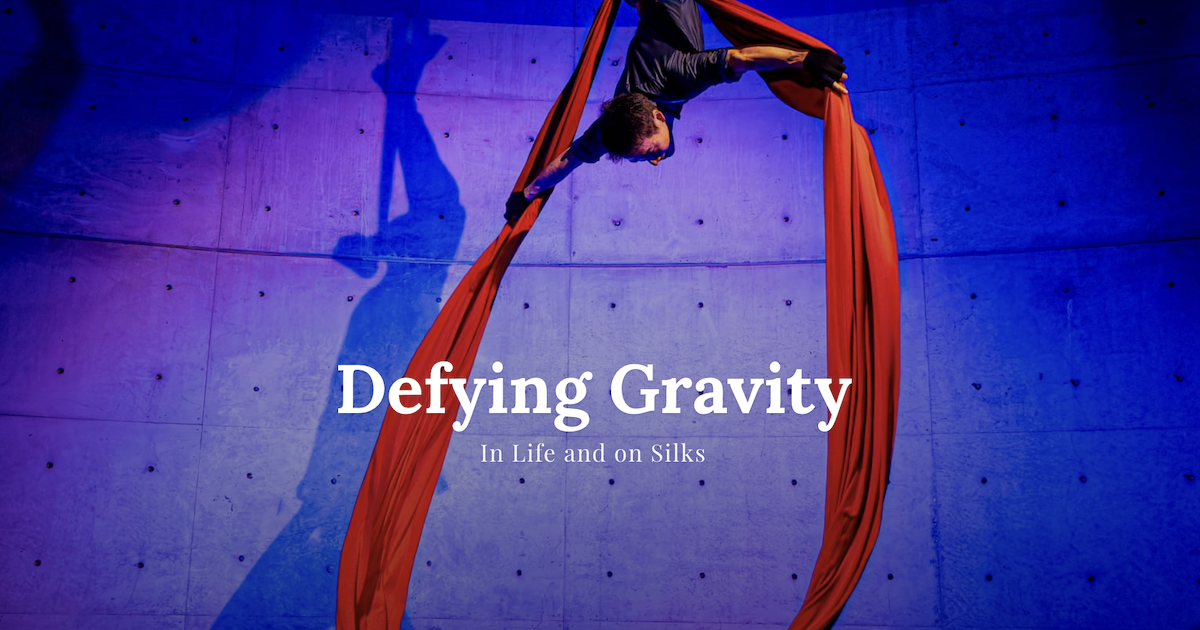
In A Study in Spin, I wrote about what spin in aerial silks is in the first place, and how it is created. In A Study in Spin 2, I wrote about what kinds of spin to choose in terms of composition and staging. When it comes to actually learning the technique, I would also recommend this guide by our own @Moodystreetcircuskid.

Link: Centered on Silks Spin Guide
To control a spin, you first have to let your body learn what rotation feels like: the pull outward, the shift of weight, the slight delay before the silks catch up. Once those sensations begin to settle in, the next task is to find your axis, slowly and precisely.
It is tempting to pull yourself in too soon and force the spin to accelerate, but speed should come only after you have waited long enough to know, with some certainty, where your axis is.
This guide contains many cues, details, and timing points for building a clean, highly controlled spin. The sequence itself may be something you could find by searching around YouTube or Instagram, but the explanations get right to the essential points with real precision, and carry a grounded, deep understanding. It is more than enough for learning the fundamentals, and I think even intermediate aerialists who already have several spin skills, or advanced aerialists, may find in it an opportunity to reconsider the way they approach their own spins.
The same is true beyond spin. Your performance and creative work gain depth dramatically when expression is no longer, for you, merely a matter of technical ability or beauty, but a way of showing your emotion as it is. Advanced aerialists who aim for that point are precisely the ones who must imprint the fundamentals so deeply that they can execute them perfectly and unconsciously.
I also learned a great deal from this guide, especially from the axis-finding drills, and when I was teaching aerial, I sometimes used it as a basis for my own instruction.
Zoë Isadora is an aerialist whose climbs are controlled with exquisite precision and whose flow is breathtakingly beautiful, and I learned a great deal from her work not only in spin, but in many other respects as well. The range of expression in her climbs and spins is remarkably varied, and there are very few performers whose aerial work gives such a vivid sense of complex layers, as though legs, shoulders, and silks were overlapping in several strata at once.
The timing never worked out, but it seems she also came to visit LA, and if the timing had lined up, I would have loved to see her aerial work in person and receive her teaching directly.
I’ll be writing more stories for aerial lovers!
Subscribe to get notified when a new post is published.
 Tatz
Tatz
 Tatz
Tatz